From the time I was an elementary student at LTS, I knew that I wanted to go into marine science. Unfortunately for me, this was a phase that never blew over. Every science fair project I had somehow involved monitoring water quality, investigating water pollution, fish, or even culturing bacteria. I even made my 8th grade Exhibition project all about Lahontan Cutthroat trout, the Nevada state fish. While the Nevada mountains are an incredible place to grow up, they are not ideal for oceanic research. At an LTS sponsored high school fair that I reluctantly attended (as any teenager would), I was introduced to Santa Catalina School in Monterey, California. When I was accepted there, I said a tearful goodbye to Incline Village, but foraged on in my marine scientist journey. I fell in love with Catalina because of their distinguished Marine Ecology Research Program, which taught me field sampling, scientific writing, data analysis, and communication skills that I still use today. Through Catalina, I discovered Eckerd College, an elusive and tiny liberal arts school located in St. Petersburg, Florida, known for its emphasis on marine science and dedication to publishable research at the undergraduate level. When I was accepted to Eckerd with the Dean’s Scholarship, I said yet another tearful goodbye, and headed across the country to put my newly found skills in marine science to good use!
Eckerd taught me that marine science is a much vaster field than I ever knew, and that you could specialize in anything between massive marine mammals, and microorganisms so small that even a powerful microscope cannot capture them. I took great interest in marine microbiology, and focused on coral restoration at the microbial level. We determined that some bacteria can actually protect corals from certain diseases, so we sought to isolate the specific beneficial bacteria, determine their “antibiotic”-like properties, and eventually, apply this to the field as a potential “medication” to corals growing in nurseries. This project is still ongoing to this day, and it was an honor to contribute to it.
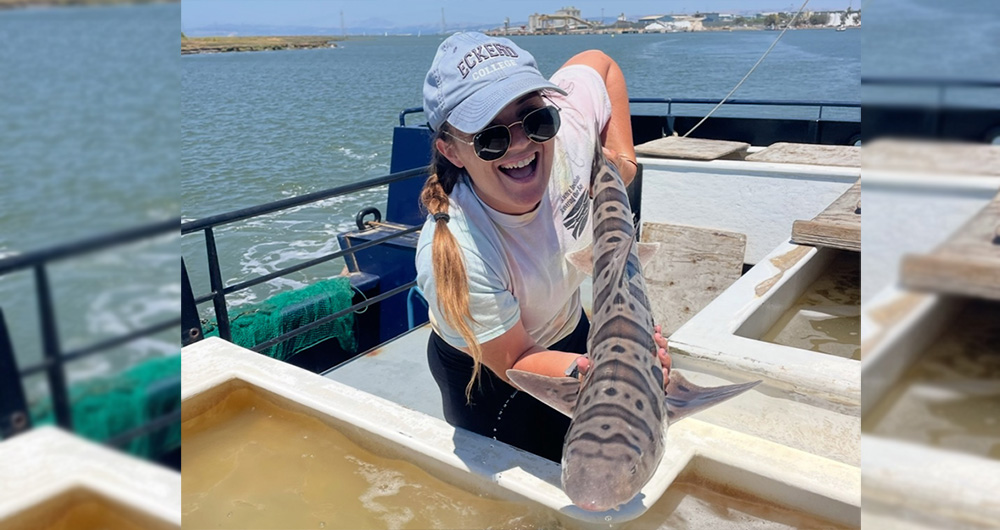
When I graduated from Eckerd, I landed a job at the Marine Science Institute in Redwood City, California, a non-profit dedicated to educating hundreds of thousands of local students a year about the San Francisco Bay marine ecosystem. Most notably, I served as a crew member on the R/V Robert G. Brownlee, a 90 ft research vessel, where we taught marine science through hands-on educational programs for students of all ages. In tandem, we conducted long-term population research on the sharks, stingrays, fish, and invertebrate that inhabited the bay. Getting to research and teach about these animals and call it “work” marked some of the best years of my life. It was among my crew members that I opened my acceptance letter to the University of Miami, where I am now pursuing a Master of Science in marine microbial ecology. My research focuses on the microbial communities that support the Floridian mangrove systems. This entails plenty of getting stuck in the mud in the mangrove forests, extensive lab work to extract the DNA of the bacteria and viruses that are inhabiting this mud, and lots of coding to make sense of the data! Along with my research, I am Teaching Assistant for our undergraduate marine science candidates, and I am working with the University of Miami Dive Safety Office to obtain my divemaster in SCUBA diving. Marine science is a much muddier path than I anticipated (literally), but I have loved every moment. I reflect often and fondly about my LTS days, and my science fair and Exhibition projects. I am so grateful to LTS for helping me discovered what I love, and for helping me explore marine science from the Nevada mountains!